Sustainable forest resource use in the Cardamom mountains in Cambodia
The project to develop sustainable, legal and traceable woodfuels value chains in Cambodia comes under the CEMAATERR programme, which aims to help reduce the carbon footprint and boost climate resilience in the rural territories and “relay towns” of Asia, West Africa and the Mediterranean.
Context and challenges
Over the past 30 years, forest ecosystems have been degraded at an unprecedented rate in Cambodia. Wood from the natural forest supplies growing demand for both the country’s households and industries for energy and timber. Illegal logging in natural forests and protected areas also contributes to deforestation and landscape degradation, without providing income or acceptable working conditions for local communities.
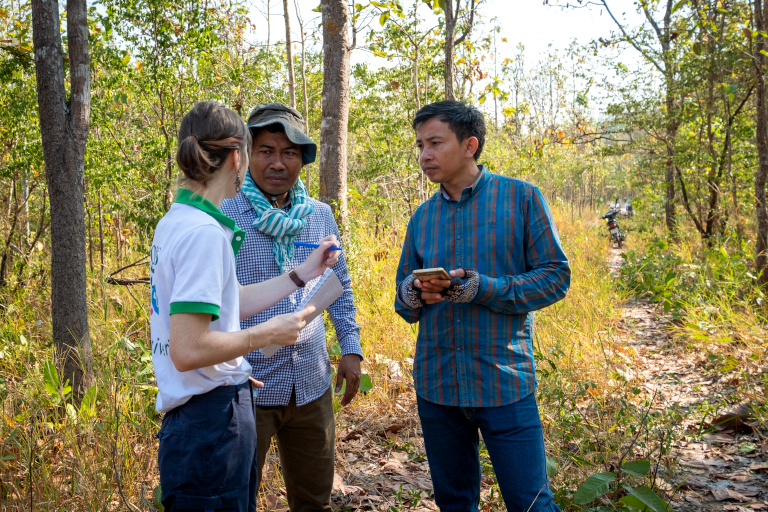
The Cardamom Mountains are one of South-East Asia’s largest remaining rainforests and is essential to the lives of millions of Cambodians. The «buffer zones» at the foot of the mountain range, found in the provinces of Kampong Chhnang and Pursat, play a key role in providing natural protection against forest degradation and climate risks.
Communities in this region are leading the fight against deforestation and forest degradation through community forests and community protected areas. However, they often lack the finance and technical expertise to manage forests and restore degraded lands.
Established in Cambodia since 1994, Geres supports the development of a sustainable, legal and profitable woodfuels value chains and the reduction of wood fuel consumption.
Project history and new objectives
From 2016 to 2019 Geres implemented the multi-donor funded SEFED project, aiming to support the emergence of sustainable supply chains in the domestic energy sector and CEMAATERRI aiming to preserve natural resources in the Cardamom Mountains through forest restoration and local economic development. This work led, among other things, to the incubation of an innovative Kjuongo business model for sustainable charcoal supply chain involving local communities. Such model was conceived as a new business concept to deliver high quality certified sustainable charcoal at a competitive price to reduce greenhouse gas emissions linked with the use of non-renewable wood fuels.
The engine of the business concept has consisted in a digital-based logistics and sales platform, which borrows its core business model from other digitalized companies like Uber and Amazon Marketplace. Building on this experience, since September 2019 Geres and its partners has implemented the Kjuongo/CEMAATERRII project to test, validate and scale up this business model.
Previous activities enabled the local communities to restore 18 hectares of forest cover and to preserve 3502 hectares of forest. 225 community members have been trained in sustainable forest management and plantation best practices. Besides, revenues have increase for 173 people (9,300 US dollars generated).
The project continues today with three axes to help improve local living conditions, preserve forests reduce greenhouse gases and increase resilience to climate change:
- Support to local communities for the restoration, management and sustainable development of 3,600 hectares of forest
- Development of a sustainable, traceable and legal charcoal value chain, working with local communities and charcoal producers. Khmer Green Charcoal (KGC), a social enterprise manages distribution and sales.
- Building the capacity of communities, local authorities and government agencies on forestry and energy planning
Technical partners
- Khmer Green Charcoal
- Cambodian Ministry of Agriculture, Forestry and Fisheries
- Cambodian Ministry of the Environment
- United Nations Development Programme (UNDP)
- UNEP-DTU Partnership
FINANCIAL PARTNERS

French Development Agency (AFD)
Maisons du Monde Foundation
The Maisons du Monde Foundation is committed to supporting projects to preserve forests, reassert the value of wood and mobilize its employees. In this regard, it supports the work of Geres in South-East Asia to assist forest communities and combat deforestation.
MORE INFORMATION
FIND OUT MORE
Cambodia
Projects news
WOULD YOU LIKE TO TAKE ACTION
AND SUPPORT WHAT WE DO?
Tell us who you are and find your means of action.
CITIZENS
Because Climate Solidarity is a challenge we face collectively, Geres gives you the possibility to make a difference. TAKE ACTION AS A CITIZENPRIVATE SECTOR
As a business executive, an employee or a customer, you have the power to take action in your everyday life. TAKE ACTION AS A COMPANYLOCAL AND INSTITUTIONAL ACTORS
Support our actions in France and internationally and become an agent of change at our side. TAKE ACTION AS AN INSTITUTIONFOUNDATIONS
By supporting Geres, you contribute to the implementation of innovative and concrete actions. TAKE ACTION AS A FOUNDATIONThe post Sustainable forest resource use in the Cardamom mountains in Cambodia appeared first on Geres.
]]>Promotion of sustainable energy practices in the garment sector in Cambodia
Increasing competitiveness and decreasing environmental impact through sustainable production in the Cambodian garment industry.
Context and challenges
The Cambodia’s garment industry is the backbone of the country’s export-driven economy and the industrial sector’s largest employer. The sector is expanding, and this is reflected in its growing energy demand, with total final consumption increasing by about 11% between 2010 and 2015.
According to the draft Energy Efficiency (EE) Policy, steep growth has led to the doubling of GHG emissions from energy consumption in the sector between 2002 and 2012. The predominant use of unsustainable, non-traceable cheap fuelwood in the factories of Cambodian garment suppliers contributes to the country’s rapid forest depletion and further exacerbates the sector’s ecological footprint.
As of today, Geres estimates that 70% of the wood burnt by garment factories comes from natural forests – mainly from illegal harvesting and questionable land clearing practices.

Objectives and solutions
Therefore, since 2016, GERES has worked on solutions to support low-carbon development by industries in Cambodia by tackling the barriers towards a switch to sustainable biomass energy supply for thermal energy generation, with a focus on the garment manufacturing sectors. In 2019 Geres completed a study to assess the technical and economic feasibility to operate a switch towards sustainable biomass fuels for H&M suppliers.
However, many challenges are to be addressed such as the inadequate regulatory environment to incentivize private investment in sustainable energy practices; the lack of appropriate dedicated technical and financial services and the low demand from the garment industry for sustainable energy solutions. In particular, the latter is caused by several factors such as:
- A low level of awareness within factories of existing energy-efficient and cleaner energy solutions
- A lack of understanding of the methodologies used to calculate energy savings
- Lack of coordinated strategy among brands on environmental requirement.

In order to address the above challenges, Geres has partnered with the Global Green Growth Institute (GGGI) and the Garment Manufacturer’s Association in Cambodia to implement a joint project with the aim to increase investments in sustainable energy practices by garment factories in Cambodia.
The project is funded through European Union’s SWITCH Asia programme and aims to achieve the following:
- Relevant government institutions initiate a series of regulatory measures to incentivize private investment in sustainable energy practices.
- Institutional arrangements and capacities are developed for adoption of enforcement measures and improve data availability supporting the sector’s switch to sustainable energy practices.
- Garment factories have access to a range of appropriate technical and financial services including a risk reduced repayment mechanism to support their switch towards sustainable energy practices.
- Awareness is raised and demand for appropriate technologies and advisory services for sustainable energy practices increases among value chain stakeholders.
Geres leads operations in this area, by facilitating energy audits conducted by external auditors in selected garment factories, demonstrating the potential benefits of adopting more sustainable energy practices, informing interested manufacturers about appropriate technology solutions, providing technical assistance and developing appropriate training.
We also rally international brands sourcing from Cambodia to take coordinated action towards sustainable production in their supply chain.
Technical partners
- GGGI (Global Green Growth Institute)
- GMAC (Garment Manufacturers Association in Cambodia)
FINANCIAL PARTNER

WOULD YOU LIKE TO TAKE ACTION
AND SUPPORT WHAT WE DO?
Tell us who you are and find your means of action.
CITIZENS
Because Climate Solidarity is a challenge we face collectively, Geres gives you the possibility to make a difference. TAKE ACTION AS A CITIZENPRIVATE SECTOR
As a business executive, an employee or a customer, you have the power to take action in your everyday life. TAKE ACTION AS A COMPANYLOCAL AND INSTITUTIONAL ACTORS
Support our actions in France and internationally and become an agent of change at our side. TAKE ACTION AS AN INSTITUTIONFOUNDATIONS
By supporting Geres, you contribute to the implementation of innovative and concrete actions. TAKE ACTION AS A FOUNDATIONThe post Promotion of sustainable energy practices in the garment sector in Cambodia appeared first on Geres.
]]>Promoting sustainable cooking stoves in Cambodia
Geres has helped reduce biomass demand in Cambodia by introducing the improved New Lao Stove fireplace. More than 4 million were produced and distributed during this project, which ran from 1997 to 2016.
Context and challenges
At 70 percent – one of the highest in Southeast Asia – of a country’s energy mix, biomass is Cambodia’s top energy source, more than 90 percent of which is sourced from woodfuel (wood and charcoal).
Of the final biomass energy demand, domestic cooking is responsible for more than 70 percent, making cooking the largest driver of the consumption of wood – 4.3 million tons or 2 million ton oil equivalent total consumption annually – and charcoal – approximately 1 million ton oil equivalent of forest wood total consumption – in the Kingdom, the unsustainable collection and production of which, in some areas, are found to be direct drivers of deforestation.
To help households manage their woodfuel consumption, Geres developed various improved cookstove technologies suitable for the different markets – rural, peri-urban, urban – and supported commercialization by engaging the private sector, including by establishing an association of producers and distributors (Improved Cookstove Producers and Distributors Association of Cambodia) and supporting the commercial activities of its members, in order to facilitate widescale dissemination of efficient biomass cooking devices.

From objectives to actions
- Local stove producers invested in equipment and managed the production activities, from purchasing raw materials to selling the final products.
- Geres trainers taught stove producers on ICS manufacturing techniques, and connected the producers with other stakeholders along the supply chain.
- Geres supported the industry association’s (ICoProDAC) organizational and business development efforts in order for it to be capable of performing important quality control and monitoring, and business support, functions to members.
- Geres supported the awareness raising of consumer groups and the promotion of improved cookstoves through sales events and group promotion activities to enhance market demand for improved cookstoves.
- Geres supported the development of the dissemination network through the engagement and the training of retailers in new areas, and the link with existing distributors to extend outreach and serve more consumer groups.
From actions to impacts
- More than 3.6 million improved cookstoves – New Lao Stove and Neang Kongrey Stove – disseminated since 1997
- 1,954,000 tonnes of wood saved from 2003 to 2013
- 2,901,825 TCO2eq avoided from 2003 to 2013

Partners
Financial partners
- Asia Regional Cookstove Program (ARECOP)
- Asian Development Bank
- Australian Aid
- Blue Moon Fund
- Cambodian Ministry of Agriculture, Forestry and Fisheries
- Cambodian Ministry of Mines and Energy (MME)
- Cambodian Ministry of the Environment
- Centre de coopération Internationale en Recherche Agronomique pour le Développement (CIRAD)
- ENEA Consulting
- European Union
- French Development Agency (AFD)
- Global Alliance for Clean Cookstoves (GACC)
- UNDP GEF
- World Bank ESMAP
Technical partners
- Forestry administration of Cambodia
- Asia Regional Cookstove Program (ARECOP)
- Centre de coopération Internationale en Recherche Agronomique pour le Développement (CIRAD)
- ENEA Consulting
- Global Alliance for Clean Cookstoves (GACC)
- Institut des Standards du Cambodge (ISC)
DOCUMENT TO DOWNLOAD
Outcomes Magazine
This publication tells the story of improved stoves in Cambodia promoted by Geres between 2003 and 2013.
WOULD YOU LIKE TO TAKE ACTION
AND SUPPORT WHAT WE DO?
Tell us who you are and find your means of action.
CITIZENS
Because Climate Solidarity is a challenge we face collectively, Geres gives you the possibility to make a difference. TAKE ACTION AS A CITIZENPRIVATE SECTOR
As a business executive, an employee or a customer, you have the power to take action in your everyday life. TAKE ACTION AS A COMPANYLOCAL AND INSTITUTIONAL ACTORS
Support our actions in France and internationally and become an agent of change at our side. TAKE ACTION AS AN INSTITUTIONFOUNDATIONS
By supporting Geres, you contribute to the implementation of innovative and concrete actions. TAKE ACTION AS A FOUNDATIONThe post Promoting sustainable cooking stoves in Cambodia appeared first on Geres.
]]>Improving the traditional process of palm sugar production in Cambodia
Reducing the energy demand of small-scale producers for an optimized production with a low environmental cost
Context and challenges
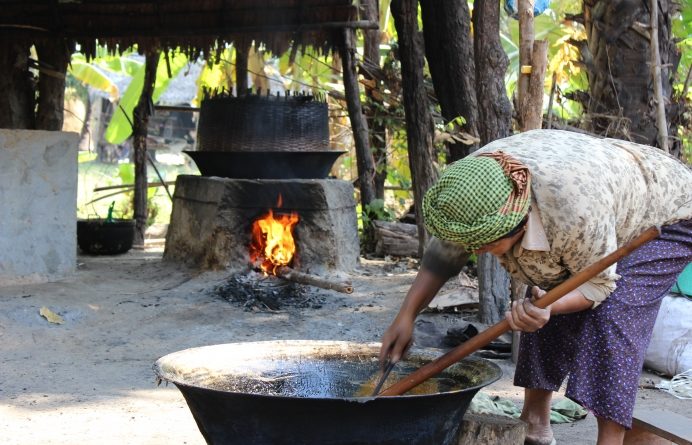
In developing countries, household-scale industrial activities represent an invaluable source of money and local jobs. In rural areas of Cambodia, food processing is the second largest income-generating activity after farming, and contributes to both poverty alleviation and food security of local communities. At the same time, these activities involve the combustion of significant quantities of wood fuels, often inefficiently.
Objectives and solutions
Geres raises awareness among local palm sugar producers on alternative cooking solutions for their activities, and offers technical assistance in adopting, building and operating more efficient stoves, which allow producers to save up to 30% of firewood, while improving the quality of their end-product.
Geres also developed a brand for this quality, environment-friendly sugar, to offer to palm sugar producers a higher market accessibility and a guaranteed premium buying price. Sovannak Palm Sugar is now operating as a viable social enterprise.
From objectives to actions
Geres, through the involvement and training of local stove manufacturers and installers, provides an improved palm sap cooking technology.
Local palm sugar producers process the sap into high quality granulated palm sugar following strict quality requirements regarding hygiene and traceability. They save money on fuel, increase their sales price and reduce the environmental burden of their activity.
- Sovannak Palm Sugar Enterprise offers a premium, guaranteed price to palm sugar producers, and distributes the end product both locally and abroad.
- From actions to impacts
- 2,4 tons CO2 equivalent saved per ton of sugar produced
- 54 tons of sugar provuced using GERES improved solutions up to 2013
Project partners
Financial partners
- Planète Bois
- Improved Cookstove Producers & Distributors Association of Cambodia (ICoProDAC)
- ETC Energy
- World Bank/ ESMAP programme
- Ensemble Foundation
- Sovannak Palm Sugar Enterprise
- Kampong Speu Palm Sugar Association
- Forestry Administration of Cambodia
- UNDP – GEF
- Ministry of Mines and Energy (MME)
- Alstom
Technical partners
- Improved Cookstove Producers & Distributors Association of Cambodia (ICoProDAC)
- Sovannak Palm Sugar Enterprise
- Administration Forestière du Cambodge
- Association des producteurs de sucre de palme de Kampong Speu
WOULD YOU LIKE TO TAKE ACTION
AND SUPPORT WHAT WE DO?
Tell us who you are and find your means of action.
CITIZENS
Because Climate Solidarity is a challenge we face collectively, Geres gives you the possibility to make a difference. TAKE ACTION AS A CITIZENPRIVATE SECTOR
As a business executive, an employee or a customer, you have the power to take action in your everyday life. TAKE ACTION AS A COMPANYLOCAL AND INSTITUTIONAL ACTORS
Support our actions in France and internationally and become an agent of change at our side. TAKE ACTION AS AN INSTITUTIONFOUNDATIONS
By supporting Geres, you contribute to the implementation of innovative and concrete actions. TAKE ACTION AS A FOUNDATIONThe post Improving the traditional process of palm sugar production in Cambodia appeared first on Geres.
]]>