Escaping energy poverty in the Provence-Alpes-Côte d’Azur region
Reducing social inequalities and speeding up the energy transition for all in Marseille, in the Provence-Alpes-Côte d’Azur region.
Context and challenges
In France, in 2019, around 12% of the population was experiencing energy poverty as a result of high energy costs in relation to low incomes. This issue affects the most vulnerable households, especially single-parent families and people living alone, many of whom are women.
The direct consequences include debt, social withdrawal or exclusion and harmful effects on health connected with the development of mould and the cold.
The Provence-Alpes-Côte d’Azur region has not been spared. The coastal areas share the characteristics of the shores of the Mediterranean. Stress on the property market forces the lowest income households to fall back on the most energy-hungry housing: missing or inefficient heating and cooling systems, poor insulation and dilapidated building stock.
3.5 million households are facing energy poverty. This especially affects the poorest 30% of the French population. (Source: ONPE)
Mild winters are punctuated with harsher periods, while increasingly hot summers result in considerable discomfort and sometimes dangerous situations (makeshift heating systems, obstruction of ventilation, etc). Climate change increases the vulnerability of these households everywhere and deepens social inequalities.

Objectives and solutions
With more than 20 years’ experience in the sector, Geres has been placing its expertise and network at the service of the battle against energy poverty.
Its efforts are designed to boost the power to act of households facing energy poverty. The programme begun in 2019 strives to:
- Extend the network of intermediaries helping to identify affected households, especially to health and personal service professionals for purposes of the energy advice home visits.
- Provide complete answers by mobilizing and training the stakeholders in contact with the households.
- Implement appropriate solutions: individual support including energy advice home visits and assistance with essential works, as well as collective workshops to boost the power to act.
- Facilitate access to finance, through the creation of a fund to assist with essential work.
- Raise awareness of health risks: health/environment/energy workshops for families and intermediaries liaising with health professionals.
- Conduct an advocacy campaign calling for local and national policies to take account of this issue
The programme targets women in particular, tailoring solutions and involving them in identifying vulnerable families, as well as helping them to gain a better understanding of their role.
EmpowerMed, a programme handing power back to women in the face of energy poverty
This Geres programme of action is mainly conducted as part of a European Horizon 2020 project: EmpowerMed, “Empowering women to take action against energy poverty”
Find out more about our European EmpowerMed action programme
The consortium has nine partner members in the Mediterranean and Germany. Through sharing practices and developing common methodologies, it aims to improve the quality of life and health of affected people in the Mediterranean coastal areas by reducing energy poverty.
See the project videos
The partners
Financial partners
- European Union
- Solinergy Endowment fund
- Valorem – Watt for change fund
- Rexel Foundation
- Legallais Foundation
- Les petites pierres Endowment fund
- Qualitel Endowment fund and its partner FASE
- Colis Privé
- Enerlis Solidarité
Technical partners
- Impulse Toit, getting people on job placement schemes to carry out essential work
- Women in Europe for a Common Future (WECF)
- European partners (Spain, Italy, Slovenia, Croatia, Albania and Germany)
DOWNLOAD DOCUMENTS
The partners

union européenne
L'Union européenne est une association politico-économique sui generis de vingt-huit États européens qui délèguent ou transmettent par traité l’exercice de certaines compétences à des organes communautaires.

Fonds de dotation Solinergy
Fonds Valorem - Watts for Change
Le Fonds VALOREM – Watt for change a l’ambition de promouvoir l’accès aux énergies renouvelables pour le développement local, l’amélioration des conditions de vie et la protection de l’environnement. Le Fonds VALOREM nous soutient depuis 2019 sur des actions de lutte contre la précarité énergétique en France.

fondation rexel
La Fondation Rexel souhaite mettre son savoir-faire et son expertise au service de la lutte contre la précarité énergétique, et nous soutient depuis 2016 sur des actions répondant à cet enjeu, en Asie et en France.

Fonds de dotation QUALITEL
En 2020, le Fonds de dotation QUALITEL et son partenaire mécène le Fonds d'Action pour la Sécurité Electrique FASE, soutiennent les actions de lutte contre la précarité énergétique portées par le Geres, dans le cadre de son appel à projets en soutien aux initiatives emblématiques et novatrices en faveur du logement des plus défavorisés.

Fonds d'Action pour la Sécurité Électrique
En 2020, le Fonds d'Action pour la Sécurité Electrique FASE, partenaire du Fonds de dotation QUALITEL, soutient les actions de lutte contre la précarité énergétique portées par le Geres.

Fonds de dotation les Petites Pierres
Le Fonds de dotation les Petites Pierres et ses partenaires, ont soutenu les actions de lutte contre la précarité énergétique portées par le Geres, en doublant les dons de la campagne de crowdfunding réalisée en octobre 2020 sur la plateforme Les petites pierres.

Fondation Legallais
Enerlis Solidarité

Colis privé
Colis privé s'engage à soutenir notre projet de lutte contre la précarité énergétique à Marseille.
Ce spécialiste de la livraison de colis à domicile et en relais pour les particuliers, dans un délai de 24h à 48h est un acteur majeur du dernier kilomètre.

La fondation des amis du Festival de Cannes
WOULD YOU LIKE TO TAKE ACTION
AND SUPPORT WHAT WE DO?
Tell us who you are and find your means of action.
CITIZENS
Because Climate Solidarity is a challenge we face collectively, Geres gives you the possibility to make a difference. TAKE ACTION AS A CITIZENPRIVATE SECTOR
As a business executive, an employee or a customer, you have the power to take action in your everyday life. TAKE ACTION AS A COMPANYLOCAL AND INSTITUTIONAL ACTORS
Support our actions in France and internationally and become an agent of change at our side. TAKE ACTION AS AN INSTITUTIONFOUNDATIONS
By supporting Geres, you contribute to the implementation of innovative and concrete actions. TAKE ACTION AS A FOUNDATIONThe post Escaping energy poverty in the Provence-Alpes-Côte d’Azur region appeared first on Geres.
]]>Energy and ecological transition for a sustainable agriculture
Geres supports agricultural actors to reduce environmental impacts and help them adapt to climate change.
Context and challenges
Agriculture in Provence-Alpes-Côte d’Azur is atypical. It is marked by its diversity and the presence of permanent crops (viticulture, arboriculture, crops under cover, etc.), natural meadows and a lesser representation of large-scale crops. For nearly 10 years, the region has been in the lead for organic farming, with 18.8% of cultivated agricultural land, compared to 8.5% at the national level.
Regional agriculture consumes more energy per hectare than the national average, which highlights the high dependence of farms on fossil fuels, in connection with their specificity (heating of greenhouses for horticultural production and tomatoes in winter, need for cold during the vinification of rosé, conservation in cold rooms…).
Finally, Mediterranean soils are among the poorest in organic matter, an aggravating factor of drought and desertification.
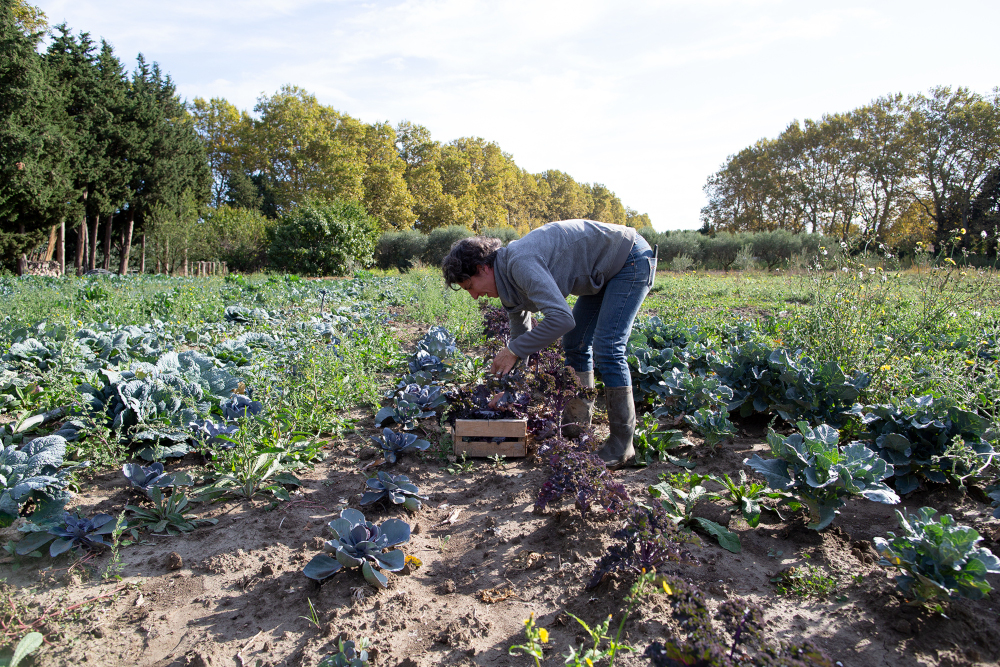
Today, the most important challenge for the agricultural sector is to reduce environmental impacts while maintaining an economic activity. Many farmers are engaged in a responsible approach, looking for sustainable solutions, for a resilience to climate change.
Objectives and solutions
In order to support farmers in the energy and ecological transition, Geres works with the actors of the profession along several lines:
- Raising farmers’ awareness of the impacts of their activity: energy consumption, greenhouse gas emissions, and air pollution generated by the burning of crop residues, poor manure use and mineral fertilization
- Reduce energy consumption: to heat greenhouses, for machinery, to keep crops cold…
- Measuring the energy performance of agricultural tools and advising farmers to reduce greenhouse gases
- Develop bridges between the agricultural world and local authorities, for local agriculture, via the implementation of a circular economy of bio-waste (green and food waste)
- Disseminate best practices to regional farms, through a network of agricultural professionals committed to the transition
Beneficiaries
- 15 farmers and riding schools and 2 agricultural high schools involved in reducing air pollution
- 10 farmers and 2 agricultural high schools supported on the 4/1000 experiment
- 6 pilot farmers tested different bioclimatic greenhouse models
- 5 farmers, 3 communities and 3 demonstration sites use a bioclimatic greenhouse
- 3200 farmers who have completed their self-diagnosis online
- 10 institutional partners
Technical partners
- Organizations involved in the IRAEE: Bio de Provence-Alpes-Côte d’Azur, Regional Chamber of Agriculture, Maison Régionale de l’Elevage, Filière Cheval Sud, CRIPT PACA (agricultural education), Solagro, Lycée agricole de Carpentras
- Partner structures for the dissemination of bioclimatic greenhouses: Agrithermic research office, Groupe de Recherche en Agriculture Biologique (GRAB)
- Partner structures for the valorization of green waste in agriculture: Regional Chamber of Agriculture, Bio de Provence-Alpes-Côte d’Azur, CIVAM, Gesper
MORE INFORMATION
Factsheet
Geres supports agricultural actors to reduce environmental impacts and help them adapt to climate change.
A website
Numerous resources, from IRAEE projects coordinated by Geres, for farmers and other agricultural professionals
Bioclimatic greenhouse guide
This guide has been produced to answer farmers’ questions.
Financial partners
Agence de l’Environnement et de la Maîtrise de l’Énergie
L’Agence de l’Environnement et de la Maîtrise de l’Energie (ADEME) est un établissement public à caractère industriel et commercial placé sous la tutelle conjointe du ministère de la Transition écologique et solidaire et du ministère de l’Enseignement supérieur, de la Recherche et de l’Innovation. L’ADEME participe à la mise en œuvre des politiques publiques dans les domaines de l’environnement, de l’énergie et du développement durable.

Région Sud Provence-Alpes-Côte d'Azur
Le Conseil Régional de Provence-Alpes-Côte d’Azur est l’assemblée délibérante de la Région PACA, collectivité territoriale décentralisée agissant sur le territoire régional Provence-Alpes-Côte d’Azur. Son siège se trouve à Marseille. Depuis 2018, le Conseil Régional utilise "région Sud – Provence-Alpes-Côte d’Azur" au lieu de l’acronyme PACA.

fond de dotation itancia
Le fonds de dotation Itancia soutient des projets concrets et innovants en France et sur le continent africain, qui visent à préserver notre planète. Le Fonds de dotation Itancia, nous soutient depuis 2012 sur des actions menées en France et au Maroc, notamment sur la réalisation d’un projet pilote de développement de serres solaires passives pour une agriculture durable en Région Provence-Alpes-Côte d’Azur.
WOULD YOU LIKE TO TAKE ACTION
AND SUPPORT WHAT WE DO?
Tell us who you are and find your means of action.
CITIZENS
Because Climate Solidarity is a challenge we face collectively, Geres gives you the possibility to make a difference. TAKE ACTION AS A CITIZENPRIVATE SECTOR
As a business executive, an employee or a customer, you have the power to take action in your everyday life. TAKE ACTION AS A COMPANYLOCAL AND INSTITUTIONAL ACTORS
Support our actions in France and internationally and become an agent of change at our side. TAKE ACTION AS AN INSTITUTIONFOUNDATIONS
By supporting Geres, you contribute to the implementation of innovative and concrete actions. TAKE ACTION AS A FOUNDATIONThe post Energy and ecological transition for a sustainable agriculture appeared first on Geres.
]]>Developing educational tools on composting
In partnership with stakeholders in environmental education and sustainable development, Geres designed a transversal tool on the theme of composting in 2011.
Context and challenges
Encouraged by new regulations, composting is an excellent way of recycling household waste that can be adopted at all levels: from the home to industrial installations through to the whole local community.

Objectives and solutions
However, there are still no specific educational materials on composting aimed at schools. Looking at existing environmental education materials, Geres favors designing materials that can be adjusted depending on:
- the intended aim: from simple information to changing behaviour
- the type of audience: suitable for each stage of education (middle or secondary school) and environmental education activities beyond the school context
Partners
Technical partners
-
GRAINE PACA (Réseau régional pour l’éducation à l’environnement)
Funder partners
- ADEME Provence-Alpes-Côte d’Azur
- Région Provence-Alpes-Côte d’Azur
To go further
WOULD YOU LIKE TO TAKE ACTION
AND SUPPORT WHAT WE DO?
Tell us who you are and find your means of action.
CITIZENS
Because Climate Solidarity is a challenge we face collectively, Geres gives you the possibility to make a difference. TAKE ACTION AS A CITIZENPRIVATE SECTOR
As a business executive, an employee or a customer, you have the power to take action in your everyday life. TAKE ACTION AS A COMPANYLOCAL AND INSTITUTIONAL ACTORS
Support our actions in France and internationally and become an agent of change at our side. TAKE ACTION AS AN INSTITUTIONFOUNDATIONS
By supporting Geres, you contribute to the implementation of innovative and concrete actions. TAKE ACTION AS A FOUNDATIONThe post Developing educational tools on composting appeared first on Geres.
]]>Essential energy work at home in France
From 2011 to 2014, Geres carried out 400 home interventions in modest households to help them reduce their energy bills.
Context and challenges
In Provence-Alpes-Côte d’Azur, 600,000 people are in a situation of energy poverty: they face difficulties to pay their energy bills or maintain a minimum comfort in their housing. With the rise in electricity prices and the stagnation or even the loss of income, this phenomenon is worsening.
From 2011 to 2014, GERES carried out 400 home-based1 interventions for modest households. This field experience has made it possible to identify a need and a lever of action for energy maintenance work in the home, for which no suitable solution exists, neither in the public sector nor in the market.
Objectives and solutions
However, the repair of a water leak, the installation of a time-based switch for an electric water heater, the caulking of the pipes or openings, the installation of glazing (etc.) are as much effective means to contain overconsumption, reduce the amount of bills and improve comfort in housing.
Watch the project video
Fuel poverty: acting in low-income households
Partners
Funders partners
- Provence-Alpes-Côte d’Azur Region
- Fondation Rexel
Technical partners
- Association Compagnons Bâtisseurs
- Le CEDER (Centre pour l’Environnement et le Développement des Énergies Renouvelables)
WOULD YOU LIKE TO TAKE ACTION
AND SUPPORT WHAT WE DO?
Tell us who you are and find your means of action.
CITIZENS
Because Climate Solidarity is a challenge we face collectively, Geres gives you the possibility to make a difference. TAKE ACTION AS A CITIZENPRIVATE SECTOR
As a business executive, an employee or a customer, you have the power to take action in your everyday life. TAKE ACTION AS A COMPANYLOCAL AND INSTITUTIONAL ACTORS
Support our actions in France and internationally and become an agent of change at our side. TAKE ACTION AS AN INSTITUTIONFOUNDATIONS
By supporting Geres, you contribute to the implementation of innovative and concrete actions. TAKE ACTION AS A FOUNDATIONThe post Essential energy work at home in France appeared first on Geres.
]]>Towards a positive local energy in the Mediterranean
Development and sustainable integration of energy efficiency and renewable energy solutions adapted to specific territorial conditions in 11 European countries
Context and challenges
COMPOSE is a European project of the Interreg Mediterranean programme, of which Geres is the French partner. One of the priority areas of the European Union’s program dedicated to the Mediterranean regions is to promote low-carbon strategies and energy efficiency in three typologies of territories: cities, islands and rural territories.
The COMPOSE project is built on the experience of previous initiatives to provide a synthetic model for integrating renewable energy and energy efficiency into territorial planning.
Objectives and solutions
- Contribute to the energy transition of the territories covered by the project by setting up 15 pilot actions related to energy efficiency and renewable energies. In the Provence-Alpes-Côte d’Azur region, Geres is developing local energy efficiency services in partnership with local structures: home visits, socio-energy diagnostics and related advice, particularly for low-income households.
- Promote the development of skills of the territories (elected representatives, technical services, experts) on the concrete implementation of action plans related to the project’s themes.
Valuing local potentials and strengthening the green economy. - Capitalization and dissemination of the project’s lessons throughout the Mediterranean region as well as to the political authorities of the European Union.
Partners
Technical partners
- Project coordinator : Chambre d’Agriculture et des Forêts de Slovénie – Institut Maribor
- Energy agencies (Portugal, Croatia)
- Universities: Tirana (Albania), Technical University of Crete (Greece)
- Kyoto Club (Italia), Institute for Strategic Studies and Prognoses (Montenegro)
- Local collectivities : City of Granollers (Spain), City of Srebrenik (Bosnia), City of Lakatamia (Cyprus)
Financial partners
- European Union (FEDER) / MED Programme
- seeking Local co-funders
To go futher
Your contact at Geres:
Marie-Maud GERARD, COMPOSE referent
WOULD YOU LIKE TO TAKE ACTION
AND SUPPORT WHAT WE DO?
Tell us who you are and find your means of action.
CITIZENS
Because Climate Solidarity is a challenge we face collectively, Geres gives you the possibility to make a difference. TAKE ACTION AS A CITIZENPRIVATE SECTOR
As a business executive, an employee or a customer, you have the power to take action in your everyday life. TAKE ACTION AS A COMPANYLOCAL AND INSTITUTIONAL ACTORS
Support our actions in France and internationally and become an agent of change at our side. TAKE ACTION AS AN INSTITUTIONFOUNDATIONS
By supporting Geres, you contribute to the implementation of innovative and concrete actions. TAKE ACTION AS A FOUNDATIONThe post Towards a positive local energy in the Mediterranean appeared first on Geres.
]]>Acting and innovating against fuel poverty in PACA
Geres and its partners have set themselves the objective of supporting 250 low-income households and continuing to promote the personalised system to combat fuel poverty in Provence-Alpes-Côte d’Azur between 2015 and 2017.
Context and challenges
In Provence-Alpes-Côte d’Azur, 600,000 people are in a situation of energy poverty: they face difficulties to pay their energy bills or maintain a minimum comfort in their housing. With the rise in electricity prices and the stagnation or even the loss of income, this phenomenon is worsening.
The direct consequences for these families are indebtedness, withdrawal or social exclusion and negative impacts on their health.
Communities and social landlords are motivated to take action but struggle to identify effective lines of action.
From 2011 to 2014, Geres experimented locally, evaluated and capitalized with 6 European partners, a transferable and adaptable intervention methodology for each territory. In the field of fuel poverty for more than 10 years, Geres has continued to explore needs and new solutions to deal with them.

Suggested solutions
Geres and its partners are proposing to support 250 low-income households and continue to disseminate in the PACA region the personalized system for combating fuel poverty. The project involves the training of three professional induction officers who will carry out interventions in the homes of households. They will provide families with advice, small and economical equipment, and referral to appropriate services, enabling them to sustainably reduce their water and energy costs.
The project plans to scale up interventions by transferring the methodology to local authorities, professional actors and social landlords so that they can appropriate the system and implement it on their territory with 400 additional households.
To continuously improve the effectiveness of the system, the project also provides for the creation of a management and data capitalization tool as well as the implementation of a pilot project for the realization of energy efficiency projects. first level among households.
Watch the project video
Partners
Technical partners
- CLER (Réseau pour la Transition énergétique)
- RREP (Réseau Régional Energie Précarité)
- Ecopolenergie
- Médiance 13
Financial partners
- ADEME
- Provence-Alpes-Côte d’Azur Region
- REUNICA
WOULD YOU LIKE TO TAKE ACTION
AND SUPPORT WHAT WE DO?
Tell us who you are and find your means of action.
CITIZENS
Because Climate Solidarity is a challenge we face collectively, Geres gives you the possibility to make a difference. TAKE ACTION AS A CITIZENPRIVATE SECTOR
As a business executive, an employee or a customer, you have the power to take action in your everyday life. TAKE ACTION AS A COMPANYLOCAL AND INSTITUTIONAL ACTORS
Support our actions in France and internationally and become an agent of change at our side. TAKE ACTION AS AN INSTITUTIONFOUNDATIONS
By supporting Geres, you contribute to the implementation of innovative and concrete actions. TAKE ACTION AS A FOUNDATIONThe post Acting and innovating against fuel poverty in PACA appeared first on Geres.
]]>Passive solar energy and sustainable agriculture
Bioclimatic greenhouses are an energy-efficient and relevant production tool for small and medium-sized farms in the south of France. Geres supports pilot projects.
Context and challenges
The current context regarding access to energy and climate change requires the agricultural sector, which is strongly concerned, to integrate these new environmental constraints by controlling energy consumption and reducing greenhouse gas emissions.
Greenhouse production is very energy intensive. It represents 27% of the total direct energy consumed by regional agriculture.
In Provence-Alpes-Côte d’Azur, agriculture remains an important local economic activity but the conditions are difficult: sometimes harsh climate, reduction of available land, dependence on mass commercial channels that threatens the viability of local farms….
Rural territories are looking for alternatives to boost their agricultural sector and help farmers adapt to market constraints and energy and climate challenges.
Many operators are looking for sustainable solutions to make their business viable, including short circuit marketing.

Objectives and solutions
For 15 years, Geres has been spreading bioclimatic agricultural greenhouses in the cold regions of Central Asia. Constructed using simple techniques with local materials, these greenhouses show very good thermal performance allowing good yields even in difficult climatic conditions. They represent a productive tool that is energy efficient and relevant for small and medium-sized farms.
The development of new models adapted to the context of the PACA region, through 5 pilot bioclimatic greenhouses, aims to provide answers for:
- Diversification of production, and in particular empowerment with regard to the supply of seedlings (old varieties, plants for organic farming …)
- The extension of the cropping season for a better exploitation profitability
- Production at altitude favoring the establishment or the maintenance of activity in isolated territory.
Watch the project video
Partners
Financial partners
- Regional office of ADEME (French agency for environment and Energy saving)
- Provence-Alpes-Côte d’Azur Region
Technical partners
- Agrithermic
- Groupe de Recherche en Agriculture Biologique
WOULD YOU LIKE TO TAKE ACTION
AND SUPPORT WHAT WE DO?
Tell us who you are and find your means of action.
CITIZENS
Because Climate Solidarity is a challenge we face collectively, Geres gives you the possibility to make a difference. TAKE ACTION AS A CITIZENPRIVATE SECTOR
As a business executive, an employee or a customer, you have the power to take action in your everyday life. TAKE ACTION AS A COMPANYLOCAL AND INSTITUTIONAL ACTORS
Support our actions in France and internationally and become an agent of change at our side. TAKE ACTION AS AN INSTITUTIONFOUNDATIONS
By supporting Geres, you contribute to the implementation of innovative and concrete actions. TAKE ACTION AS A FOUNDATIONThe post Passive solar energy and sustainable agriculture appeared first on Geres.
]]>Valorization of organic matter in Southern France
Increasing the visibility and knowledge of the regional composting and methanisation sectors is one of the priorities of this programme.
Context and issues
In PACA, 1.1 million tons of organic waste are produced annually. Most often, this waste ends up in landfills or is incinerated. However, regulations have forced a growing number of organic waste producers to sort and process.
The quantities of organic matter to be managed are increasing and the waste producers are looking for local solutions. The regional composting and methanation sectors are relevant topics.
However, these solutions are struggling to develop. Existing facilities (2 anaerobic digestion units and 60 composting platforms) are insufficient to handle all the waste produced. In addition, the lack of information of professionals is a major obstacle to the marketing of compost and the birth of new biogas projects.
Geres has been working with ADEME on these topics for more than 10 years and proposes to put its expertise at the service of the territorial development of these sectors.

Objectives and solutions
- To develop the visibility of the regional composting and methanation sectors and to reinforce the knowledge on them: creation of an online resource center and a service of advice to the producers of organic waste on the adapted solutions (fight against the waste food, cooperation of producers for collection …)
- Stimulate the emergence of anaerobic digestion projects: facilitate the path of project promoters through personalized support, the networking of waste producers and biogas project holders and support for the structuring of a regional methanation policy
- Promote the distribution and use of quality compost and promote the development of short circuits. It will network producers and users to develop the marketing of compost in a territory composed of several municipalities
- Realize an inventory of fixtures and a follow-up of the development of the two sectors at the regional level
Partners
Financial partners
- ADEME Provence-Alpes-Côte d’Azur
- Région Provence-Alpes-Côte d’Azur
- GDF-Suez
Technical partners
- Orgaterre
WOULD YOU LIKE TO TAKE ACTION
AND SUPPORT WHAT WE DO?
Tell us who you are and find your means of action.
CITIZENS
Because Climate Solidarity is a challenge we face collectively, Geres gives you the possibility to make a difference. TAKE ACTION AS A CITIZENPRIVATE SECTOR
As a business executive, an employee or a customer, you have the power to take action in your everyday life. TAKE ACTION AS A COMPANYLOCAL AND INSTITUTIONAL ACTORS
Support our actions in France and internationally and become an agent of change at our side. TAKE ACTION AS AN INSTITUTIONFOUNDATIONS
By supporting Geres, you contribute to the implementation of innovative and concrete actions. TAKE ACTION AS A FOUNDATIONThe post Valorization of organic matter in Southern France appeared first on Geres.
]]>